The Catholic League claims that its aim is to "safeguard both the religious freedom rights and the free speech rights of Catholics whenever and wherever they are threatened." But, in reality, it functions as a rather shrill organ of the Republican right, and little more. This is the fifth post in the series.
Donohue is at it again, bashing Democrats to shill for Republicans. The Pennsylvania Senate race must be giving him great pains, as the Democrat, Bob Casey, is pro-life. But that doesn't stop Donohue, who issued a press release today declaring that "Bob Casey is a fraud on abortion". All because Casey declared that he supported "initiatives which would reduce the number of abortions." I guess Donohue prefers partisan posturing to actually reducing abortion rates. He must be getting very desperate about losing Santorum. Think about it: this is the main issue that the Catholic League wants to talk about today, of all the races going on? Did you see Donohue make similar comments about Republicans and abortion? I think not.
Friday, October 27, 2006


Land of the Free (Media)? Not.
There is a myth out there about the liberal media. It's just that, a myth. In reality, the media in this country is craven before the monstrous Republican machine and dares not ask the kind of accountability questions that most western governments face on a day-to-day basis. Between false balance, Nancy Grace, and mindless celebrity gossip, the media has abrogated its public service responsibility, and the situation is only getting worse.
Case in point: the major group supporting press freedom in the world, Reporters Without Borders, has ranked the United States number 53 out of 168 in terms of press freedoms, right up there with Botswana, Croatia, and Tonga. Even places like Ghana, Serbia, and Panama do better. It is by the far the worst performance by a western industrial country, especially one that likes to dub itself the "leader of the free world".
No, in case you were in any doubt about the integrity of this ranking, look no further than the recent refusal by NBC to run ads for the upcoming Dixie Chicks documentary, on the grounds that it "disparaging to President Bush". Funnily enough, the documentary is about the Dixie Chicks being hounded, harassed, and blacklisted simply for criticizing Bush and the war party. What would Serbia do?
Case in point: the major group supporting press freedom in the world, Reporters Without Borders, has ranked the United States number 53 out of 168 in terms of press freedoms, right up there with Botswana, Croatia, and Tonga. Even places like Ghana, Serbia, and Panama do better. It is by the far the worst performance by a western industrial country, especially one that likes to dub itself the "leader of the free world".
No, in case you were in any doubt about the integrity of this ranking, look no further than the recent refusal by NBC to run ads for the upcoming Dixie Chicks documentary, on the grounds that it "disparaging to President Bush". Funnily enough, the documentary is about the Dixie Chicks being hounded, harassed, and blacklisted simply for criticizing Bush and the war party. What would Serbia do?
Dick Cheney Does His Best Jack Nicholson Impersonation
What does this exchange, when Cheney defends waterboarding, remind you of?
Cheney: And I think the terrorist threat, for example, with respect to our ability to interrogate high value detainees like Khalid Sheikh Mohammed, that's been a very important tool that we've had to be able to secure the nation. Khalid Sheikh Mohammed provided us with enormously valuable information about how many there are, about how they plan, what their training processes are and so forth, we've learned a lot. We need to be able to continue that.How about this one, from A Few Good Men?
Question: Would you agree a dunk in water is a no-brainer if it can save lives?
Cheney: It's a no-brainer for me...
Jessep: Son, we live in a world that has walls, and those walls have to be guarded by men with guns. Who's gonna do it? You?! You, Lieutenant Weinberg?! I have a greater responsibility than you can possibly fathom. You weep for Santiago and you curse the Marines. You have that luxury. You have the luxury of not knowing what I know: that Santiago's death, while tragic, probably saved lives. And my existence,while grotesque and incomprehensible to you, saves lives! You don't want the truth because deep down in places you don't talk about at parties, you want me on that wall! You need me on that wall! We use words like honor, code, loyalty. We use these words as the backbone of a life spent defending something. You use them as a punchline. I have neither the time nor the inclination to explain myself to a man who rises and sleeps under the blanket of the very freedom that I provide, and then questions the manner in which I provide it! I would rather you just said, "Thank you," and went on your way. Otherwise, I suggest you pick up a weapon and stand a post. Either way, I don't give a damn what you think you are entitled to!
Kaffee: Did you order the Code Red?
Jessep: I did the job I was sent to do--
Kaffee: Did you order the Code Red?!
Jessep: You're goddamn right I did.
Evil Begets Evil...
The fall-out from the torture scandal continues. An Al Qaeda operative, Iban al Shakh al Libbi, was sent to Egypt to be tortured. It turns out that one of the things he "confessed" to was a strong link between Al Qaeda and Saddam Hussein. In turn, this found its way to Dick Cheney's desk, and the rest is history. This is the same Cheney that recently defended the use of waterboarding, a favorite method of the Khmer Rouge, as a "no brainer".
Tuesday, October 24, 2006
Catholic League Watch (Monster Catch-Up Edition)
The Catholic League claims that its aim is to "safeguard both the religious freedom rights and the free speech rights of Catholics whenever and wherever they are threatened." But, in reality, it functions as a rather shrill organ of the Republican right, and little more. I have doing some exposes recently, but most of the really good stuff is in the past. Thankfully, we have access to press statements since 1997, except for the ones Donohue actually withdrew.
Here, I want to look at the different ways the Catholic League has approached Republican and Democratic politicians. And yes, there is a big difference. I'm certainly sympathetic to some of Donohue's positions, including his hounding of Terry McAuliffe for listing Catholics for a Free Choice under the "Catholic" banner on the DNC website. And sure, Donohue did go after the blatant attempt by Hastert and House Republicans to deny a Catholic priest the position of Congressional chaplain. But these instances are few and far between.
More Republican Partisan than Catholic...
One thing Donohue likes to do his to hound Democratic politicians for anti-Catholicism, while letting Republicans off the hook. Sure, a lot of this is about abortion, but much is also about lesser issues on the moral radar, such as school vouchers. There is a lob of legitimate diversity of opinion on this matter, though you would not know it from Donohue. It's almost a "non-negotiable" for him, and he beats Democrats over the head with it constantly.
Another Donohue favorite is the "under God" in the pledge of allegiance. He even calls for the impeachment of judges who oppose it. How is this a particularly Catholic issue? It isn't. But Donohue is quite the constitutional scholar! To wit: "It should be unconstitutional for the U.S. Supreme Court to overturn an act of Congress unless it is a unanimous decision."
Donohue also thinks public display of the Ten Commandments is one of the pressing issues of our day. Interestingly, he attacked the ACLU for making the point that the Ten Commandments that the fundamentalists want displayed is not the Catholic version. He says that "it matters not a whit whether it is the Catholic, Protestant, to Jewish version". Really? One would think a so-called Catholic organization would be defending the Catholic version.
Donohue also likened the position of those who argue against tax cuts for the rich to "the greedy want to keep the money they've earned; those who want to take it from us are the altruists". What a remarkable statement about Catholic social teaching!
Donohue seems conflicted on the constitutional amendment to ban gay marriage. On the one hand, he notes (correctly) in 2006 that "reasonable people may disagree whether a constitutional amendment is the right remedy". Well, in 2004, he claimed that "President Bush did the right thing by supporting a constitutional amendment to ban marriage between two men or two women." and denounced Democrats who opposed it. Again, when in doubt, go with Bush.
The Iraq war created a dilemma for Donohue. The pope and the church opposed it, but Donohue stuck with his real magisterium, the Bush administration. First Donohue claimed, falsely, that Pope John Paul never said that there was "no legal or moral justification for the war". Second, he denounced those who "exploited" the pope's position while nor respecting "his teaching on all subjects". Of course, Donohue means only those teachings consistent with the Republican agenda. Interestingly, Donohue reserves his main ire for Catholic entities, like the National Catholic Reporter.
Of course, you will not see Donohue bashing politicians for supporting an unjust war or torture, not will be ever give credit for opposing the death penalty, or supporting policies to reduce poverty or extend healthcare. No, "prudential judgment" only works in one direction for Donohue. For any attempt by those on the political left to invoke religion is attacked by Donohue as more politics than religion. Ironic. He sneers that one of these "moderates" was one who counseled Bill Clinton after his "encounter with Monica Lewinsky". Gasp. Moreover, he devotes a huge amount of attention to defending Mel Gibson, who has left the Catholic church for his own kooky sect, even going as far as to dub him "Saint Mel".
Clinton and Gore
Where to begin? A recess appointment in 1999 was deemed "Clintonesque", and James Inhofe was lauded for standing up to this "abuse of congressional recess". No comment when Bush did it for John Bolton. Elsewhere Donohue makes reference to the "Kennedy clan's predilection for spinning the truth". Gore is constantly hounding for the nonsense about fundraising in a Buddhist temple, contrasting it with his opposition to school vouchers. Gore was also mercilessly attacked for some fundraiser at the Playboy mansion that Donohue dubbed the "Gorgy". Charming. And Hillary Clinton is denounced for befriending the Weinsteins. Still, this is all pretty tame stuff compared to what would come in the later years.
Bush and Kerry
John Kerry entered Donohue's imagination in 2004. Sure, a lot of what he talks about is Kerry's position on abortion. But there's a lot more. He repeats the "flip flop" canard from GOP talking points. He lambasts Kerry over his "refusal to answer questions regarding the annulment he sought of his first marriage". I don't recall him commenting on republican paragons of marital virtue like Ronald Reagan, Newt Gingrich, and Henry Hyde. No, Kerry gets special treatment. Donohue also drags out the tired old Catholics for a Free Choice weblink, and tries to tar Kerry with this one too.
Special venom is reserved for Kerry's religious outreach people. He claimed that the resume of the first one (Mara Vanderslice) is "that of a person looking for a job working for Fidel Castro". Another outreach director (Brenda Peterson) is lambasted for opposing "under God" in the pledge of allegiance, as if this is an important issue. Funny, back in 1997, Donohue was bashing Clinton for not having a Catholic liaison. Contrast also his treatment of Kerry's religion advisers with his defense of Deal Hudson, Bush's liaison, that clearly crossed the line: after allegations that Hudson got a disturbed 18-year old student drunk and had sex with her, Donohue blamed the girl, decrying the allegations of a "drunken female he met in a bar." You see, the right can do not wrong, even when it comes to sexual sin.
When it comes to religion, Donohue's narrative is simple. Bush is religious, Kerry is a phony. So when Kerry talks about religion (such as when he stated the Catholic belief that both faith and good deeds are required for salvation) he is denounced as a hypocrite, and insincere. Donohue is disgusted by Kerry trying to defend his religiosity, asking "whether Kerry is playing politics with his religion". Seriously. To Kerry, "religion is an enigma". Donohue even feels the need to list friends of Kerry's who claim he is not religious.
And Bush? Well, the Bush love-fest is something else. Bush is lauded constantly for his interest in faith-based initiatives. Donohue actually entitled a 2003 press release "Is Bush too Holy to be President?" and claim that his opponents "put words in his mouth and then denounce him for saying what he never said." In 2004, he comes out with the fantastic statement that "most observers, regardless of their political bent, agree that President George W. Bush seems at home with his Christianity". And after Bush's 2004 victory, Donohue proclaimed that "most Americans appreciate and admire President George W. Bush for his strong religious convictions". Elsewhere Donohue quotes approvingly Bob Woodward's claim that Bush "prayed for the strength to do the Lord's will" before the Iraq war. He says that Bush turned to God for wisdom. Clearly Bush didn't listen to God, but that's another story. Donohue also presented a number of anti-Bush quotes as evidence that "we need to build more asylums".
Forgiving Republicans and Hounding Democrats
With Donohue, Democrats can't really win, nor can Republicans really lose. Examples are legion:
* Way back in 1997, Donohue defended Ralph Reed from charges of anti-Catholicism. You see, he "provided a blurb: for a book he wasn't familiar with. The real problem is the "eagerness of Reed's critics to exploit this incident for political purposes."
*During the 2000 election, the Catholic League was light on Bush for appearing at Bob Jones university, and accused John McCain of "demagoguery" and of playing the "politics of fear" for raising Bob Jones's anti-catholic and racist background. When Bush apologized, Donohue claimed that this settled the issue, and talked about Christian forgiveness. People who kept raising the issue were engaging in a "smear tactic" for "political profit".
* Donohue seems to be defending Bob Jones backers a lot. When John Ashcroft received an honorary degree, and was criticized, Donohue leapt to his defense, calling it "much ado about nothing" and declaring that Ashcroft was right to attack his opponent for raising the issue. And in a classic Donohue twist, he turns the table and declares that those accusing Ashcroft of anti-Catholicism are the real Catholic bashers.
*In 2004, he also lets one of the swiftboaters of John Kerry off the hook for harmless anti-Catholic remarks that he apologized for (no mention of the sin of calumny).
*More recently, in 2006, Kenneth Blackwell, the Republican candidate for governor of Ohio (seriously behind in the polls) was accused of anti-Catholicism because he is "co-authoring a book with someone who once made anti-Catholic quips." Blackwell, says Donohue, "deserves an immediate apology from those who slandered him."
* After launching a huge assault on the DNC for the Catholics for a Free Choice link, they finally caved. What was Donohue's reaction? "We will not congratulate the DNC for doing the right thing... this victory is oh, so sweet." No, nothing about Christian forgiveness here, just partisan childishness.
* When confronted with the anti-Catholic statements of some of the evangelicals at the "Justice Sunday" rally, where some even branded Catholicism a false religion, Donohue thought it was no big deal. His excuse? That's that's what they believe, and "I'm prepared to join hands in the culture war". Of course, Donohue's tried and tested response to to attack the attackers; in this case, he says it is "fat-cat, left-wing bigots like George Soros who concern us" whereas "Dobson is our friend."
* In response to a critique of Harriet Miers for believing in biblical inerrancy and salvation by faith alone, Donohue implicitly defends these non-Catholic claims by saying that the real intent of the critique is "Look out, this dame is dangerous."
* And after years of denouncing Democrats for refusing to march in the St. Patrick's Day parade, what is Donohue's response when Hillary Clinton does so in 2006? Gratitude? Forget it. He decision is "grounded in politics and deceit".
Here, I want to look at the different ways the Catholic League has approached Republican and Democratic politicians. And yes, there is a big difference. I'm certainly sympathetic to some of Donohue's positions, including his hounding of Terry McAuliffe for listing Catholics for a Free Choice under the "Catholic" banner on the DNC website. And sure, Donohue did go after the blatant attempt by Hastert and House Republicans to deny a Catholic priest the position of Congressional chaplain. But these instances are few and far between.
More Republican Partisan than Catholic...
One thing Donohue likes to do his to hound Democratic politicians for anti-Catholicism, while letting Republicans off the hook. Sure, a lot of this is about abortion, but much is also about lesser issues on the moral radar, such as school vouchers. There is a lob of legitimate diversity of opinion on this matter, though you would not know it from Donohue. It's almost a "non-negotiable" for him, and he beats Democrats over the head with it constantly.
Another Donohue favorite is the "under God" in the pledge of allegiance. He even calls for the impeachment of judges who oppose it. How is this a particularly Catholic issue? It isn't. But Donohue is quite the constitutional scholar! To wit: "It should be unconstitutional for the U.S. Supreme Court to overturn an act of Congress unless it is a unanimous decision."
Donohue also thinks public display of the Ten Commandments is one of the pressing issues of our day. Interestingly, he attacked the ACLU for making the point that the Ten Commandments that the fundamentalists want displayed is not the Catholic version. He says that "it matters not a whit whether it is the Catholic, Protestant, to Jewish version". Really? One would think a so-called Catholic organization would be defending the Catholic version.
Donohue also likened the position of those who argue against tax cuts for the rich to "the greedy want to keep the money they've earned; those who want to take it from us are the altruists". What a remarkable statement about Catholic social teaching!
Donohue seems conflicted on the constitutional amendment to ban gay marriage. On the one hand, he notes (correctly) in 2006 that "reasonable people may disagree whether a constitutional amendment is the right remedy". Well, in 2004, he claimed that "President Bush did the right thing by supporting a constitutional amendment to ban marriage between two men or two women." and denounced Democrats who opposed it. Again, when in doubt, go with Bush.
The Iraq war created a dilemma for Donohue. The pope and the church opposed it, but Donohue stuck with his real magisterium, the Bush administration. First Donohue claimed, falsely, that Pope John Paul never said that there was "no legal or moral justification for the war". Second, he denounced those who "exploited" the pope's position while nor respecting "his teaching on all subjects". Of course, Donohue means only those teachings consistent with the Republican agenda. Interestingly, Donohue reserves his main ire for Catholic entities, like the National Catholic Reporter.
Of course, you will not see Donohue bashing politicians for supporting an unjust war or torture, not will be ever give credit for opposing the death penalty, or supporting policies to reduce poverty or extend healthcare. No, "prudential judgment" only works in one direction for Donohue. For any attempt by those on the political left to invoke religion is attacked by Donohue as more politics than religion. Ironic. He sneers that one of these "moderates" was one who counseled Bill Clinton after his "encounter with Monica Lewinsky". Gasp. Moreover, he devotes a huge amount of attention to defending Mel Gibson, who has left the Catholic church for his own kooky sect, even going as far as to dub him "Saint Mel".
Clinton and Gore
Where to begin? A recess appointment in 1999 was deemed "Clintonesque", and James Inhofe was lauded for standing up to this "abuse of congressional recess". No comment when Bush did it for John Bolton. Elsewhere Donohue makes reference to the "Kennedy clan's predilection for spinning the truth". Gore is constantly hounding for the nonsense about fundraising in a Buddhist temple, contrasting it with his opposition to school vouchers. Gore was also mercilessly attacked for some fundraiser at the Playboy mansion that Donohue dubbed the "Gorgy". Charming. And Hillary Clinton is denounced for befriending the Weinsteins. Still, this is all pretty tame stuff compared to what would come in the later years.
Bush and Kerry
John Kerry entered Donohue's imagination in 2004. Sure, a lot of what he talks about is Kerry's position on abortion. But there's a lot more. He repeats the "flip flop" canard from GOP talking points. He lambasts Kerry over his "refusal to answer questions regarding the annulment he sought of his first marriage". I don't recall him commenting on republican paragons of marital virtue like Ronald Reagan, Newt Gingrich, and Henry Hyde. No, Kerry gets special treatment. Donohue also drags out the tired old Catholics for a Free Choice weblink, and tries to tar Kerry with this one too.
Special venom is reserved for Kerry's religious outreach people. He claimed that the resume of the first one (Mara Vanderslice) is "that of a person looking for a job working for Fidel Castro". Another outreach director (Brenda Peterson) is lambasted for opposing "under God" in the pledge of allegiance, as if this is an important issue. Funny, back in 1997, Donohue was bashing Clinton for not having a Catholic liaison. Contrast also his treatment of Kerry's religion advisers with his defense of Deal Hudson, Bush's liaison, that clearly crossed the line: after allegations that Hudson got a disturbed 18-year old student drunk and had sex with her, Donohue blamed the girl, decrying the allegations of a "drunken female he met in a bar." You see, the right can do not wrong, even when it comes to sexual sin.
When it comes to religion, Donohue's narrative is simple. Bush is religious, Kerry is a phony. So when Kerry talks about religion (such as when he stated the Catholic belief that both faith and good deeds are required for salvation) he is denounced as a hypocrite, and insincere. Donohue is disgusted by Kerry trying to defend his religiosity, asking "whether Kerry is playing politics with his religion". Seriously. To Kerry, "religion is an enigma". Donohue even feels the need to list friends of Kerry's who claim he is not religious.
And Bush? Well, the Bush love-fest is something else. Bush is lauded constantly for his interest in faith-based initiatives. Donohue actually entitled a 2003 press release "Is Bush too Holy to be President?" and claim that his opponents "put words in his mouth and then denounce him for saying what he never said." In 2004, he comes out with the fantastic statement that "most observers, regardless of their political bent, agree that President George W. Bush seems at home with his Christianity". And after Bush's 2004 victory, Donohue proclaimed that "most Americans appreciate and admire President George W. Bush for his strong religious convictions". Elsewhere Donohue quotes approvingly Bob Woodward's claim that Bush "prayed for the strength to do the Lord's will" before the Iraq war. He says that Bush turned to God for wisdom. Clearly Bush didn't listen to God, but that's another story. Donohue also presented a number of anti-Bush quotes as evidence that "we need to build more asylums".
Forgiving Republicans and Hounding Democrats
With Donohue, Democrats can't really win, nor can Republicans really lose. Examples are legion:
* Way back in 1997, Donohue defended Ralph Reed from charges of anti-Catholicism. You see, he "provided a blurb: for a book he wasn't familiar with. The real problem is the "eagerness of Reed's critics to exploit this incident for political purposes."
*During the 2000 election, the Catholic League was light on Bush for appearing at Bob Jones university, and accused John McCain of "demagoguery" and of playing the "politics of fear" for raising Bob Jones's anti-catholic and racist background. When Bush apologized, Donohue claimed that this settled the issue, and talked about Christian forgiveness. People who kept raising the issue were engaging in a "smear tactic" for "political profit".
* Donohue seems to be defending Bob Jones backers a lot. When John Ashcroft received an honorary degree, and was criticized, Donohue leapt to his defense, calling it "much ado about nothing" and declaring that Ashcroft was right to attack his opponent for raising the issue. And in a classic Donohue twist, he turns the table and declares that those accusing Ashcroft of anti-Catholicism are the real Catholic bashers.
*In 2004, he also lets one of the swiftboaters of John Kerry off the hook for harmless anti-Catholic remarks that he apologized for (no mention of the sin of calumny).
*More recently, in 2006, Kenneth Blackwell, the Republican candidate for governor of Ohio (seriously behind in the polls) was accused of anti-Catholicism because he is "co-authoring a book with someone who once made anti-Catholic quips." Blackwell, says Donohue, "deserves an immediate apology from those who slandered him."
* After launching a huge assault on the DNC for the Catholics for a Free Choice link, they finally caved. What was Donohue's reaction? "We will not congratulate the DNC for doing the right thing... this victory is oh, so sweet." No, nothing about Christian forgiveness here, just partisan childishness.
* When confronted with the anti-Catholic statements of some of the evangelicals at the "Justice Sunday" rally, where some even branded Catholicism a false religion, Donohue thought it was no big deal. His excuse? That's that's what they believe, and "I'm prepared to join hands in the culture war". Of course, Donohue's tried and tested response to to attack the attackers; in this case, he says it is "fat-cat, left-wing bigots like George Soros who concern us" whereas "Dobson is our friend."
* In response to a critique of Harriet Miers for believing in biblical inerrancy and salvation by faith alone, Donohue implicitly defends these non-Catholic claims by saying that the real intent of the critique is "Look out, this dame is dangerous."
* And after years of denouncing Democrats for refusing to march in the St. Patrick's Day parade, what is Donohue's response when Hillary Clinton does so in 2006? Gratitude? Forget it. He decision is "grounded in politics and deceit".
The Fruits of the Bush Administration
Manfred Nowak, the United Nations special rapporteur on torture, is frustrated. Whenever he criticizes the treatment of detainess in various countries, one standard response is increasingly thrown in his face: we are only doing what the United States is doing. Yes, evil acts like torture have a way of fostering other evils in many ways, predictable and unpredictable. Bush is wearing the One Ring...
Monday, October 23, 2006
Theology and Torture
As noted many time, torture was condemned explicitly the the Second Vatican Council. In particular, Gaudium Et Spes says:
Pretty strong words. Some have quibbled with this, however. They note that the Church has not always condemned torture, and anyway, how could John Paul raise a group of issues that the Council called "shameful" to the status of "intrinsically evil"? The latter issue has been dealt with by Cardinal Avery Dulles, in the context of slavery (he didn't address torture directly). But Dulles disputed the overall notion that John Paul had somehow changed church teachings. Appealing to Jacques Maritain, he argues that:
But what about the Church's behavior in the past? Didn't it condone torture, and even proscribe rules for use during the Inquisition? Well, we need to make some clear distinctions. For a start, the evil of torture was explictly recognized as far back as 866, by Pope Nicholas I. Still, the Church failed to speak out more often than not, and was often complicit in torture. But it is not so simple. Using the same logic as Dulles, Michael Liccione argues:
"The varieties of crime are numerous: all offenses against life itself, such as murder, genocide, abortion, euthanasia and willful suicide; all violations of the integrity of the human person, such as mutilation, physical and mental torture, undue psychological pressures; all offenses against human dignity, such as subhuman living conditions, arbitrary imprisonment, deportation, slavery, prostitution, the selling of women and children, degrading working conditions where people are treated as mere tools for profit rather than free and responsible persons: all these and the like are criminal: they poison civilization; and they debase the perpetrators more than the victims and militate against the honor of the creator."In his 1993 encyclical Veritatis Splendour, Pope John Paul II went even further, defining torture (and other things on this list) as intrinsically evil (intrinsece malum), namely "acts which per se and in themselves, independently of circumstances, are always seriously wrong by reason of their object." These acts "do not allow for any legitimate exception. They do not leave room, in any morally acceptable way, for the "creativity" of any contrary determination whatsoever." Moreover "circumstances or intentions can never transform an act intrinsically evil by virtue of its object into an act "subjectively" good or defensible as a choice."
Pretty strong words. Some have quibbled with this, however. They note that the Church has not always condemned torture, and anyway, how could John Paul raise a group of issues that the Council called "shameful" to the status of "intrinsically evil"? The latter issue has been dealt with by Cardinal Avery Dulles, in the context of slavery (he didn't address torture directly). But Dulles disputed the overall notion that John Paul had somehow changed church teachings. Appealing to Jacques Maritain, he argues that:
"Radical forms of slavery that deprive human beings of all personal rights are never morally permissible, but more or less forms of subjegation and servitude will always accompany the human condition. The elimination of slavery, possible in our time, corresponds to a natural dynamism of the human spirit toward freedom and personal responsibility. The goal of full and uninhibited freedom, however, is an eschatological ideal never fully attainable within history."In other words, no core doctrine has been altered or reversed. As Dulles puts it: "The formulation of revealed truth develops through the discernment of new truths that are formally implicit in the apostolic deposit." What about torture? Although Dulles does not address it directly, the same argument would hold. Torture is intrinsically evil if and when it violates the God given dignity and integrity (the intrinsic worth) of human beings. Now, even though this cannot be defined precisely, the old pornography "I'll know it when I see it" standard holds.
But what about the Church's behavior in the past? Didn't it condone torture, and even proscribe rules for use during the Inquisition? Well, we need to make some clear distinctions. For a start, the evil of torture was explictly recognized as far back as 866, by Pope Nicholas I. Still, the Church failed to speak out more often than not, and was often complicit in torture. But it is not so simple. Using the same logic as Dulles, Michael Liccione argues:
Zippy Catholic makes the following distinction:"The Church has not changed her doctrine; she has developed it by better understanding and making more explicit the logical consequences of truths she has always professed. Accordingly, she has put the particular sin of torture behind her."
"There is a fundamental difference, though, between a doctrinal teaching and a juridical decision. When Church administrators (including the Pope) make juridical decisions, they are not exercising the teaching office of the Magisterium."Think of it this way: the unchanged teaching of the Church was that torture was licit, if doing so would serve the common good. Liccione notes:
"But the Church's development of doctrine has it that the torture and execution of people for their religious beliefs is a violation of their consciences, which is intrinsically evil inasmuch as it violates one of the most basic of human rights.... That is what the Western-European wars of religion and the rise of popular government taught the Church even though should it have been obvious much earlier than that... Even though [this notion] is a remote application of moral principles pertaining to the depositum fidei, it is not itself such a principle and in fact relies, like geocentrism, on an empirically mistaken belief to get where it goes from such principles."Therefore, according to Catholic theology, torture is indeed intrinsically evil, and admits of no exceptions, and the seeming discontinuity is not of a nature that should cast doubt on the veracity of this teaching.
The Theology of Voting Guides
More and more are jumping into the fray. Bishop Sheridan of Colorado Springs declared that Catholics who "vote for politicians in favor of abortion rights, stem-cell research, euthanasia or gay marriage may not receive Communion until they recant and repent in the confessional." Hmm. Maybe so much close proximity to James Dobson and his ilk caused the good bishop's brain to go a little squishy.
Of course, this is nonsense. I discussed the voting guide issues in great detail here. The crux of the argument is that voting for a candidate is not the same thing as voting for the act itself, and can be justified under certain circumstances. In one of the most cogent analyses of the issue, Christopher Decker sets out the arguments in a pair of papers, Moral Theology for the Voting Booth and Voting and "Non-Negotiable" Issues. Decker applies the well-known principle of double effect from Catholic moral theology. In a nutshell, an act that may lead to foreseeable evil consequences can be morally licit if three conditions hold: (i) the act in itself is not evil; (ii) the evil effect is not intended as a means or an end; (iii) the good attained is proportionate to the evil arising from the act. It typically boils down to the third condition. Decker argues that, in judging this condition, a number of further factors come into play, including: would the candidate have the power advance this particular policy? Would the candidate be effective in causing the policy to be enacted? And, if the policy is enacted, would it be effective in achieving its ends? Finally, the relative gravity of the good and evil effects must be taken into account. Nothing here is certain, and the person must act in the realm of probability, which of course allows for prudential judgment.
Yet again, I will take the default abortion example. Take as a given that the voter who supports a pro-abortion candidate does not share that person's views on abortion. Nonetheless, voting for that person is perfectly licit as long as the third condition of the principle of double effect holds. What factors come into play? Will voting for a candidate have any impact on the abortion rate? What if this particular elected office holds little power to influence abortion legislation? For example, it could be a candidate for some local government position. Even if national office, would this person actually be in a position to affect the abortion rate? In the United States, the "right" to abortion derives from the Supreme Court. Plus, the pro-abortion candidate may well support a bevy of economic and healthcare policies that actually reduce the rate of abortion. Remember the evidence from the Clinton administration. And if abortion was made illegal, would this actually reduce the abortion rate? Evidence from Latin America suggests not. As for relative gravity, consider 655,000 dead Iraqis versus no change in the abortion rate.
(Any reader who would like a copy of Decker's essays should e-mail me, and I will forward them-- with the permission of the author of course).
Bishop Sheridan and the Catholic Answers crowd appear not to have thought these things through very carefully. Then again, if their goal is simply to dress a partisan Republican agenda in the mantle of Catholic moral theology, they have done a fine job obfuscating the issues. It's high time to rip that mantle from them, and show the world that the emperor has no clothes. I already mentioned the effects of Bush's war set against no change in abortion rates. But, as those on the right will point out, the conditions surrounding a just war are imbued with prudential judgment. Indeed they are. No, I want to pick an easier example. Torture is instrinsically evil, and can never be licit, just like abortion. So voting for a candidate that supports torture leads to exactly the same moral reasoning as the case of abortion. But remember that one of the conditions of the theory of double effect is that the evil act be not intended. How many Catholics support Bush's "coercive interrogation techniques"? How many are indifferent to it? And getting to the third factor, how does the relative gravity of voting for a person who legalizes torture play out against voting for a pro-abortion candidate who would not have made the slightest difference to abortion numbers? Time to re-assess 2004 for the right-winger moralists, perhaps?
Of course, this is nonsense. I discussed the voting guide issues in great detail here. The crux of the argument is that voting for a candidate is not the same thing as voting for the act itself, and can be justified under certain circumstances. In one of the most cogent analyses of the issue, Christopher Decker sets out the arguments in a pair of papers, Moral Theology for the Voting Booth and Voting and "Non-Negotiable" Issues. Decker applies the well-known principle of double effect from Catholic moral theology. In a nutshell, an act that may lead to foreseeable evil consequences can be morally licit if three conditions hold: (i) the act in itself is not evil; (ii) the evil effect is not intended as a means or an end; (iii) the good attained is proportionate to the evil arising from the act. It typically boils down to the third condition. Decker argues that, in judging this condition, a number of further factors come into play, including: would the candidate have the power advance this particular policy? Would the candidate be effective in causing the policy to be enacted? And, if the policy is enacted, would it be effective in achieving its ends? Finally, the relative gravity of the good and evil effects must be taken into account. Nothing here is certain, and the person must act in the realm of probability, which of course allows for prudential judgment.
Yet again, I will take the default abortion example. Take as a given that the voter who supports a pro-abortion candidate does not share that person's views on abortion. Nonetheless, voting for that person is perfectly licit as long as the third condition of the principle of double effect holds. What factors come into play? Will voting for a candidate have any impact on the abortion rate? What if this particular elected office holds little power to influence abortion legislation? For example, it could be a candidate for some local government position. Even if national office, would this person actually be in a position to affect the abortion rate? In the United States, the "right" to abortion derives from the Supreme Court. Plus, the pro-abortion candidate may well support a bevy of economic and healthcare policies that actually reduce the rate of abortion. Remember the evidence from the Clinton administration. And if abortion was made illegal, would this actually reduce the abortion rate? Evidence from Latin America suggests not. As for relative gravity, consider 655,000 dead Iraqis versus no change in the abortion rate.
(Any reader who would like a copy of Decker's essays should e-mail me, and I will forward them-- with the permission of the author of course).
Bishop Sheridan and the Catholic Answers crowd appear not to have thought these things through very carefully. Then again, if their goal is simply to dress a partisan Republican agenda in the mantle of Catholic moral theology, they have done a fine job obfuscating the issues. It's high time to rip that mantle from them, and show the world that the emperor has no clothes. I already mentioned the effects of Bush's war set against no change in abortion rates. But, as those on the right will point out, the conditions surrounding a just war are imbued with prudential judgment. Indeed they are. No, I want to pick an easier example. Torture is instrinsically evil, and can never be licit, just like abortion. So voting for a candidate that supports torture leads to exactly the same moral reasoning as the case of abortion. But remember that one of the conditions of the theory of double effect is that the evil act be not intended. How many Catholics support Bush's "coercive interrogation techniques"? How many are indifferent to it? And getting to the third factor, how does the relative gravity of voting for a person who legalizes torture play out against voting for a pro-abortion candidate who would not have made the slightest difference to abortion numbers? Time to re-assess 2004 for the right-winger moralists, perhaps?
Sunday, October 22, 2006
Cartoonists and Ideology
A great cartoonist or the greatEST cartoonist? In a long, fawning profile in the generally avoidable Washington Post Magazine, humorist Gene Weingarten dubs him “America's greatest living satirist, mentioned in the same breath as Mark Twain and Ambrose Bierce.” He also describes Trudeau as missing his stride in the Clinton years, only to regain it once fellow Yalie GWB took over. Trudeau is undeniably one of the best reads in the comic pages--page 3 of the Style section of the Post—with Candorville coming close as a thoughtful and funny strip that is developing quite well. Why is it that liberal cartoonists are funnier than the conservative ones?
For one, it may just be my biases (but then again, there are plenty of “liberal” comic strips I find insufferable, Non Sequitur’s occasional rambling detours into liberal musings being a prominent example). But then again, I have found it hard to find a single conservative comic strip that even merits a regular read.
Let’s take two of the most prominent ones:
One of the early ones was Mallard Fillmore, a strip about a conservative journalist who happens to be a duck. During the Clinton years, the cartoonist Bruce Tinsley, picked up every canard he could find and put it in his strip. As the Wikipedia entry for the strip notes, even in the post-2001 period, the strip has mocked Clinton more than Bush. A recent hilarious strip (September 2, 2006) in its entirety: “Liberal… n. someone who is certain that Mel Gibson is Anti-Semitic… and the United Nations isn’t.”
A more recent strip, Prickly City, consisting of a libertarian girl and a coyote, treads the same path. In early February 2005, the Chicago Tribune pulled the strip one day for an ad hominem attack on Teddy Kennedy (see this for another, tamer attack…). And its sterling respect for democratic rights right before the 2004 elections here. Blog Shrubville tracks Scott Stantis’ comic adventures.
No need to devote any space to Johnny Hart’s insane “conservative” and fundamentalist viewpoints in his comic B.C.. Just check out his strips the week of October 9, 2006, and see what you think.
I am willing to be educated—are there any good right-wing comic strips around? [And I don’t mean editorial cartoons, as there are plenty of good ones around; Daryl Cagle does a pretty good job of compiling them.] And if not, why not?
For one, it may just be my biases (but then again, there are plenty of “liberal” comic strips I find insufferable, Non Sequitur’s occasional rambling detours into liberal musings being a prominent example). But then again, I have found it hard to find a single conservative comic strip that even merits a regular read.
Let’s take two of the most prominent ones:
One of the early ones was Mallard Fillmore, a strip about a conservative journalist who happens to be a duck. During the Clinton years, the cartoonist Bruce Tinsley, picked up every canard he could find and put it in his strip. As the Wikipedia entry for the strip notes, even in the post-2001 period, the strip has mocked Clinton more than Bush. A recent hilarious strip (September 2, 2006) in its entirety: “Liberal… n. someone who is certain that Mel Gibson is Anti-Semitic… and the United Nations isn’t.”
A more recent strip, Prickly City, consisting of a libertarian girl and a coyote, treads the same path. In early February 2005, the Chicago Tribune pulled the strip one day for an ad hominem attack on Teddy Kennedy (see this for another, tamer attack…). And its sterling respect for democratic rights right before the 2004 elections here. Blog Shrubville tracks Scott Stantis’ comic adventures.
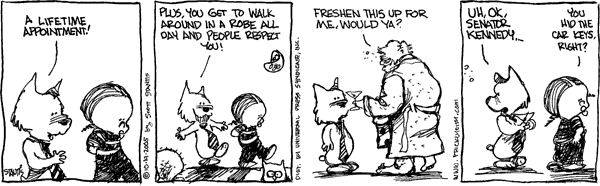
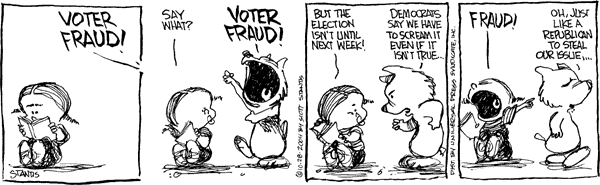
No need to devote any space to Johnny Hart’s insane “conservative” and fundamentalist viewpoints in his comic B.C.. Just check out his strips the week of October 9, 2006, and see what you think.
I am willing to be educated—are there any good right-wing comic strips around? [And I don’t mean editorial cartoons, as there are plenty of good ones around; Daryl Cagle does a pretty good job of compiling them.] And if not, why not?
Friday, October 20, 2006
From Bombay
From Bombay
I am traveling through Bombay, and can’t help share a few observations. This teeming, bustling city, despite its bad traffic, pollution (although it is nothing compared to Hong Kong or Beijing), and other not-yet-a-middle-income-country constraints, is a study in the addictive energy of an emerging power. Everywhere one sees signs of growth—more jobs being advertised, more malls being built, more cars on the road, more opportunities and excitements bubbling away—one can even feel it in the air (literally tonight, as the night sky is lit with the fireworks of the Diwali festival). The newspapers are replete with stories about salaries climbing higher, new mega building projects (mostly private) on the cards, and about societal tensions that invariably come with dizzying growth. What an intoxicating time to be in this part of the world!
Another sign of India’s growing stature is one that is at once interesting and foreboding. Even 10-15 years ago a visitor from the West to South Asia would be invariably faced with numerous questions about life in the First World, with eager, wide eyed students wanting tips for going to the Europe or the U.S. for higher education. No ones asks such questions anymore; there are plenty of opportunities at home, and hence why bother look Westward when everything that matters is going on here. This is by all means a good development, but unfortunately this has also come with an increasingly inward looking mentality. Indians, emboldened by their economic might, seem to care only about themselves. The daily newspapers that run 40-50 pages seldom devote more than a couple of pages to world affairs. Sitting here, Iraq is a paragraph, North Korea is a footnote, and the plights of those in Darfur or West Bank are simply invisible. Instead, Indians chew on their domestic issues (admittedly, there are many, many of those). The TV channels debate malfeasance of Indian politicians (Abrahamoff and Folley, who are they??), Indian terrorism (should the guilty in the Parliament attack case be hanged?), and Indian clash of cultures (caste questions continue to bedevil politics and society; Islamic law’s role in the jurisprudence is increasingly debated). Questions like what’s happening to the Republicans and Bush, what’s in store for Blair and Brown, are distant, irrelevant, and unfashionable.
I am happy that Indians are busy with themselves, but I fear that India is not preparing well to fit in its increasingly larger boots. By considering outside developments unimportant, India risks becoming a more insensitive neighbor, a shy player in world affairs, a people not willing to learn from others and not interested in helping others, and at its worst—an arrogant bully aware of its weight but uncaring of its impact. When I see A 50-page daily paper devote not a single inch to developments in Pakistan, Bangladesh, Sri Lanka, or Nepal (all four neighboring countries had newsworthy items today), or for that matter hardly any coverage of East Asia or the Middle-East, I worry about India’s sense of its neighborhood. When I see 80 channels on the Indian cable TV lineup, a dozen of which are news-related, and still can’t find out after three hours of viewing what happened in Sudan, Gaza, Afghanistan, Iran, or Ecuador today, I feel a bit uncomfortable. As Indians earn more, enjoy more, and gain power to influence more, I want them to open their eyes to the world around them, not only as market places where they can make a buck (they have already been doing that), but as societies and cultures which they can help, as well as learn and benefit from.
P.S. One place Indians remain worldly is sports. I can’t think of any other place in the world where one can watch as much live cricket, tennis, Formula One, NFL, NBA, European and Premier League Soccer as in India. Just got back from a lovely evening at the Cricket Club on India where Sri Lanka handily beat New Zealand. Now if I could only find out what’s happening at the political front in either countries!
I am traveling through Bombay, and can’t help share a few observations. This teeming, bustling city, despite its bad traffic, pollution (although it is nothing compared to Hong Kong or Beijing), and other not-yet-a-middle-income-country constraints, is a study in the addictive energy of an emerging power. Everywhere one sees signs of growth—more jobs being advertised, more malls being built, more cars on the road, more opportunities and excitements bubbling away—one can even feel it in the air (literally tonight, as the night sky is lit with the fireworks of the Diwali festival). The newspapers are replete with stories about salaries climbing higher, new mega building projects (mostly private) on the cards, and about societal tensions that invariably come with dizzying growth. What an intoxicating time to be in this part of the world!
Another sign of India’s growing stature is one that is at once interesting and foreboding. Even 10-15 years ago a visitor from the West to South Asia would be invariably faced with numerous questions about life in the First World, with eager, wide eyed students wanting tips for going to the Europe or the U.S. for higher education. No ones asks such questions anymore; there are plenty of opportunities at home, and hence why bother look Westward when everything that matters is going on here. This is by all means a good development, but unfortunately this has also come with an increasingly inward looking mentality. Indians, emboldened by their economic might, seem to care only about themselves. The daily newspapers that run 40-50 pages seldom devote more than a couple of pages to world affairs. Sitting here, Iraq is a paragraph, North Korea is a footnote, and the plights of those in Darfur or West Bank are simply invisible. Instead, Indians chew on their domestic issues (admittedly, there are many, many of those). The TV channels debate malfeasance of Indian politicians (Abrahamoff and Folley, who are they??), Indian terrorism (should the guilty in the Parliament attack case be hanged?), and Indian clash of cultures (caste questions continue to bedevil politics and society; Islamic law’s role in the jurisprudence is increasingly debated). Questions like what’s happening to the Republicans and Bush, what’s in store for Blair and Brown, are distant, irrelevant, and unfashionable.
I am happy that Indians are busy with themselves, but I fear that India is not preparing well to fit in its increasingly larger boots. By considering outside developments unimportant, India risks becoming a more insensitive neighbor, a shy player in world affairs, a people not willing to learn from others and not interested in helping others, and at its worst—an arrogant bully aware of its weight but uncaring of its impact. When I see A 50-page daily paper devote not a single inch to developments in Pakistan, Bangladesh, Sri Lanka, or Nepal (all four neighboring countries had newsworthy items today), or for that matter hardly any coverage of East Asia or the Middle-East, I worry about India’s sense of its neighborhood. When I see 80 channels on the Indian cable TV lineup, a dozen of which are news-related, and still can’t find out after three hours of viewing what happened in Sudan, Gaza, Afghanistan, Iran, or Ecuador today, I feel a bit uncomfortable. As Indians earn more, enjoy more, and gain power to influence more, I want them to open their eyes to the world around them, not only as market places where they can make a buck (they have already been doing that), but as societies and cultures which they can help, as well as learn and benefit from.
P.S. One place Indians remain worldly is sports. I can’t think of any other place in the world where one can watch as much live cricket, tennis, Formula One, NFL, NBA, European and Premier League Soccer as in India. Just got back from a lovely evening at the Cricket Club on India where Sri Lanka handily beat New Zealand. Now if I could only find out what’s happening at the political front in either countries!
Thursday, October 19, 2006
The Democrats Religion Problem, Again
The always-excellent Amy Sullivan discusses liberal attitudes to the revelations of David Kuo (former second-in-command at the White House Faith-Based Office), who noted that the Bushites were taking their evangelical backers for a ride. It's a devastating expose, showing that the religious language employed by the regime is a fraud, a cynical charade, an afterthought. Perfect ammunition for the GOP's liberal critics, right? Wrong. As Sullivan points put, the mantra that Bush is trying to implement a theocracy is so ingrained among the left, they are unwilling to change their perspective, not only in the face of evidence to the contrary, but evidence that they can actually use against the administration to garner support. Sullivan concludes:
"In fact, the real revelation of Kuo's book is not that the Bushies don't care about evangelicals; it's that liberals are too wedded to their views to capitalize on it."and
"If it turns out instead to be a political sham that produced only 1 percent of the new funds it promised for faith-based organizations, liberals need rethink their theocracy-phobia."Liberals were all over tell-alls from Paul O'Neill, Ron Suskind, and Bob Woodward. Just not David Kuo. The major liberal blogs pretty much ignored the story. And, when the topic did come up, liberal commentators tend to mock and insult the evangelicals. This should be a golden moment for the Democrats. As shown in a recent poll, the Republicans have lost a 29-percentage point advantage among frequent church-goers in recent months. Shouldn't the Democrats be trying to capitalize on this? Or are they glued to their own prejudices with all the zeal of a Bush, a Cheney, or a Rumsfeld?
Help Me Obi-Wan Bin Laden, You're My Only Hope...
One of the revelations in Suskind's The One Percent Doctrine was that the CIA was certain that Bin Laden's last minute intervention on the eve of the 2004 election was geared to help Bush. After all, Bush's Iraq debacle and overall "up-yours" attitude to foreign affairs were major terrorist recruiting tools. And of course, Bush let Bin Laden slip through the cracks in Tora Bora, and then proclaimed that he didn't really care about him.
Which brings us to the question: will Osama pop up from his cave again before these crucial mid-term elections? If he does, the Democrats should immediately pounce on the fact that he's still free after all these years, thanks to Bushite incompetence. Why is it that only Republicans seem to run Bin Laden ads?
Which brings us to the question: will Osama pop up from his cave again before these crucial mid-term elections? If he does, the Democrats should immediately pounce on the fact that he's still free after all these years, thanks to Bushite incompetence. Why is it that only Republicans seem to run Bin Laden ads?
Wednesday, October 18, 2006
Republicans Support Forced Abortions
This is an old story, but one worth retelling. The scene: the Northern Mariana islands in Micronesia. The issue: a loophole. Garments produced here were entitled to enter the US market free of quotas and tariffs, it being a US territory. In essence, garment manufacturers were allowed to place "made in the USA" labels on their products, but were not required to adhere to U.S. labor laws. The Northern Mariana islands, became, in fact, a kind of Wild West for sweatshop operators, as they brought in women from China and the Philippines, subjecting them to appalling conditions. The women were forced to work 12 hour days, for half the U.S. minimum hourly wage, and were made to live in barbed wire prisons. What's worse, the sweatshop owners forced women to became pregnant to have abortions. As a sideline, they also fostered sex slavery.
Who could support such a situation? The modern Republican party. And quite brazenly too. Inspired by Jack Abramoff, and marshaled by Tom Delay, the GOP stood squarely behind the sweatshops. Delay even praised Abramoff's shady clients:
This story just doesn't die. More recently, a Texas Republican (Ralph Hall) denounced a teenage sex slave from the floor of the House, claiming that she "wanted to do nude dancing." Don't you just love it when their real moral values come to the fore?
To conclude, I will quote again from Second Vatican Council document Gaudium Et Spes (the Pastoral Constitution on the Church in the Modern World):
Who could support such a situation? The modern Republican party. And quite brazenly too. Inspired by Jack Abramoff, and marshaled by Tom Delay, the GOP stood squarely behind the sweatshops. Delay even praised Abramoff's shady clients:
"You are a shining light for what is happening to the Republican Party, and you represent everything that is good about what we are trying to do in America and leading the world in the free-market system."All the while, Delay claims the mantle of a Christian. And then there is Ralph Reed, erstwhile head of the Christian Coalition. Reed opposed legislation to subject these islands to U.S. federal wage and worker safety laws. Reed made the following statement:
"The radical left, the Big Labor Union Bosses, and Bill Clinton want to pass a law preventing Chinese from coming to work on the Marianas Islands. [The Chinese workers] are exposed to the teachings of Jesus Christ...[and] are converted to the Christian faith and return to China with Bibles in hand."Horrendous. There's more. Allen Stayman was a State Department official advocating labor law changes in the Northern Mariana islands. As such, he was a threat to Jack Abramoff and his clients. So Ken Mehlman, who was then White House political director (now head of the Republican National Committee) had him fired. In other words, this scandal reached the highest levels of the so-called Christian Bush administration.
This story just doesn't die. More recently, a Texas Republican (Ralph Hall) denounced a teenage sex slave from the floor of the House, claiming that she "wanted to do nude dancing." Don't you just love it when their real moral values come to the fore?
To conclude, I will quote again from Second Vatican Council document Gaudium Et Spes (the Pastoral Constitution on the Church in the Modern World):
"The varieties of crime are numerous: all offenses against life itself, such as murder, genocide, abortion, euthanasia and willful suicide; all violations of the integrity of the human person, such as mutilation, physical and mental torture, undue psychological pressures; all offenses against human dignity, such as subhuman living conditions, arbitrary imprisonment, deportation, slavery, prostitution, the selling of women and children, degrading working conditions where people are treated as mere tools for profit rather than free and responsible persons: all these and the like are criminal: they poison civilization; and they debase the perpetrators more than the victims and militate against the honor of the creator."I've quoted this before in the context of torture. But what comes next is also applicable to the Republicans. One final thought: if only the Democrats were not so in the thrall of the abortion lobby, they could be hanging the "forced abortions" banner over the heads of the GOP on a daily basis. Sometimes the Democrats are simply their own worst enemy.
Santorum Gets Tolkien Analogy Wrong
Rick justifies Bush's Iraqi fiasco with the following reasoning:
But what to make of what he actually said? It's a little bizarre. It would be as if the alliance in the Lord of the Rings attempted to save Minas Tirith and Gondor by bringing down the wrath of Sauron on some far away realm, completely indifferent to the lives of the people who live in that realm. Santorum is supposed to be a Catholic. Is he seriously implying that the lives of some are worth more than the lives of others? Then again, this gels well with his consequentialist reasoning, and the Santorums of times past justified the nuclear bombing of Hiroshima and Nagasaki on precisely these grounds.
"As the hobbits are going up Mount Doom, the Eye of Mordor is being drawn somewhere else... It's being drawn to Iraq and it's not being drawn to the U.S. You know what? I want to keep it on Iraq. I don't want the Eye to come back here to the United States."First things first. I discussed the real Tolkien analogy for the Bush administration here. It is the idea that one can engage in evil to do good. This is Bush's consequentialist logic for embracing torture, the idea that it is necessary to save lives. But, as Tolkien would say, this is akin to trying to use the ring of power against the Dark Lord. The One Ring is evil, and corrupts all who wield it. That is the lesson Santorum needs to draw, himself being an advocate of using the Ring.
But what to make of what he actually said? It's a little bizarre. It would be as if the alliance in the Lord of the Rings attempted to save Minas Tirith and Gondor by bringing down the wrath of Sauron on some far away realm, completely indifferent to the lives of the people who live in that realm. Santorum is supposed to be a Catholic. Is he seriously implying that the lives of some are worth more than the lives of others? Then again, this gels well with his consequentialist reasoning, and the Santorums of times past justified the nuclear bombing of Hiroshima and Nagasaki on precisely these grounds.
C.S. Lewis Makes Sense on Marriage
Andrew Sullivan quotes the chronicler of Narnia:
"My own view is that the Churches should frankly recognise that the majority of the British people are not Christians and, therefore, cannot be expected to live Christian lives. There ought to be two distinct kinds of marriage: one governed by the State with rules enforced on all citizens, and the other governed by the Church with rules enforced by her on her own members. The distinction ought be to quite sharp, so that a man know which couples are married in a Christian sense and which are not."This is indeed the crux of the matter, as I've argued here, and it has direct relevance to the gay marriage debate. Remember, though, that Lewis was an Anglican. For him, marriage was not even a sacrament. Think about how much more resonance this should have among Catholics, as marriage assumes a whole new supernatural dimension. But there is so much muddy thinking out there, reflecting the inability to separate the sacrament--the permanent union of one man and one woman in mutual self-giving ordered toward the bearing and rearing of children-- from civil marriage, which is a legal arrangement bestowing certain rights and responsibilities. Of course, most of what passes for marriage in the secular world comes nowhere close to the sacramental ideal. And that's fine. We should not try impose Catholic conceptions of marriage on non-Catholics. We don't bat an eyelid when the secular authorities "bless" Britney Spears's 24-hour drunken Las Vegas marriage, so why do we care so much about gay marriage? Would accepting gay marriage not merely clarify the difference between the sacrament and the legal arrangement?
Monday, October 16, 2006
Kim Jong Il and J.R.R. Tolkien
The Times of London has a disturbing report from North Korea based on its infamous eugenics program, consisting of the murder of all disabled children. More than this, the regime is imbued with a sense of racial superiority, and there is a concerted effort, King Herod style, to kill the babies born to Korean women and Chinese men. The details are utterly appalling, with stories of babies thrown in baskets and left to die. Should this surprise us? If you think about it, not really. The society of North Korea is based upon a man-made ideology. Instead of God, we are presented with the deification of Kim Jong Il, underpinned by the notion of racial superiority.
What has Tolkien to do with this? Well, in a little gem of a book, Sanctifying Myth, Bradley Birzer argues that in Tolkien's world, everything that God (Illuvatar) creates is good, and that attempts of evil to create result in a "perverse mockery of Illuvatar's creation". The most prominent example are the Orcs, a hideous race created by Morgoth and Sauron (fallen angels on Tolkien's mythology) that are really corrupted Elves. Of course, since only God can create from nothing, the creation of evil is always a distortion of what is good. There is a core lesson Tolkien's writing for all of us. When human beings create their own "religions", based on ideologies that place humanity at the center, they serve only as a perverse mockery of the good that God has created. Thus communism was founded as a utopian desire to foster the betterment of the working classes, but ended up trying to control the lives and thoughts of its subjects, all the while denying the dignity of the individual. Hitlerism and Kimism are no different, creating a race-based religion, casually sliding into mass murder.
What has Tolkien to do with this? Well, in a little gem of a book, Sanctifying Myth, Bradley Birzer argues that in Tolkien's world, everything that God (Illuvatar) creates is good, and that attempts of evil to create result in a "perverse mockery of Illuvatar's creation". The most prominent example are the Orcs, a hideous race created by Morgoth and Sauron (fallen angels on Tolkien's mythology) that are really corrupted Elves. Of course, since only God can create from nothing, the creation of evil is always a distortion of what is good. There is a core lesson Tolkien's writing for all of us. When human beings create their own "religions", based on ideologies that place humanity at the center, they serve only as a perverse mockery of the good that God has created. Thus communism was founded as a utopian desire to foster the betterment of the working classes, but ended up trying to control the lives and thoughts of its subjects, all the while denying the dignity of the individual. Hitlerism and Kimism are no different, creating a race-based religion, casually sliding into mass murder.
Poverty, Peace, and Dr. Yunus
I agree with Shadhu’s post below that the choice of Dr.Yunus is a good one, given that the Nobel Peace Prize is really a prize for doing good. He absolutely deserves a prize for doing good.
But the more interesting issue is whether Dr. Yunus would have deserved a "Peace Prize" that was much more narrowly defined: a prize for an actual contribution to world peace. Here we enter deep waters. Suppose we agree that Grameen has lifted millions of people out of poverty; a proposition for which there is good evidence. Does reducing poverty really bolster peace?
The standard argument in favor of the proposition is that poverty breeds despair, which breeds radicalism and terrorism. Perhaps this is true. But I’m skeptical. Isn't it equally likely that the truly poor have too much to worry about in terms of putting food on the table, to be the slaves of whatever extremist ideology is in the wind? Note that all the 9-11 hijackers, and other prominent would-be terrorists of recent vintage have been relatively well-educated and well-to-do. I would be more inclined to believe that income has a “U-shaped” relationship to the probability of becoming a violent extremist. Bill Gates and a Bangladeshi landless laborer share a propensity not to blow up airplanes.
Maybe, then, the argument is that poverty encourages civil conflict and / or inter-state conflict? But the twentieth century is the bloodiest century on record. It is also, by far, the most prosperous century in the history of humankind. And within this exceptionally bloody century, the greatest bloodbaths of all—World Wars I and II—were fought among the richest nations. So the link between poverty and peace is, again, hard to discern.
But the more interesting issue is whether Dr. Yunus would have deserved a "Peace Prize" that was much more narrowly defined: a prize for an actual contribution to world peace. Here we enter deep waters. Suppose we agree that Grameen has lifted millions of people out of poverty; a proposition for which there is good evidence. Does reducing poverty really bolster peace?
The standard argument in favor of the proposition is that poverty breeds despair, which breeds radicalism and terrorism. Perhaps this is true. But I’m skeptical. Isn't it equally likely that the truly poor have too much to worry about in terms of putting food on the table, to be the slaves of whatever extremist ideology is in the wind? Note that all the 9-11 hijackers, and other prominent would-be terrorists of recent vintage have been relatively well-educated and well-to-do. I would be more inclined to believe that income has a “U-shaped” relationship to the probability of becoming a violent extremist. Bill Gates and a Bangladeshi landless laborer share a propensity not to blow up airplanes.
Maybe, then, the argument is that poverty encourages civil conflict and / or inter-state conflict? But the twentieth century is the bloodiest century on record. It is also, by far, the most prosperous century in the history of humankind. And within this exceptionally bloody century, the greatest bloodbaths of all—World Wars I and II—were fought among the richest nations. So the link between poverty and peace is, again, hard to discern.
Sunday, October 15, 2006
The Nobel Peace Prize to Grameen Bank
Eid came early to Bangladesh this year, with the Nobel Peace Prize going at long last to Muhammad Yunus and the Grameen Bank. Bangladeshis were ecstatic but not surprised by the news. Ever since Bill Clinton wrote in My Life that Mr. Yunus should have received the award long ago, it was just a matter of when not if.
Coincidentally, I have been reading Banker to the Poor, the autobiography of Mr. Yunus, lately. It is a highly readable book distinguished by humble candor. Mr. Yunus lovingly talks about growing up in rural and urban Bangladesh in the 1940s and 50s, traveling the world in his teens as a boy scout, living through the political and social turmoil of the era, pursuing higher education in the U.S. in the 60s, falling in love with a Russian-American and marrying her, returning to the newly independent Bangladesh, struggling professionally and personally immensely in his war-ravaged country, the latter because his foreigner wife simply could not adjust. Of course, during this period he also began to think about ways to address the acute poverty he saw around his Chittagong University campus, where he taught Economics.
I find the book a good read more for the social observations than the success story of Mr. Yunus or the Grameen Bank. Particularly compelling is the section on the initial difficulties of getting micro credit going, when rural women just wouldn't come out of their houses to talk about money, and how they could not believe their eyes when they received their first loan as they had never handled cash before. What happens to the same women in mere months is as good an example of empowerment as it gets.
On a rather sour note amid the jubilation, the Economist has come up with an article claiming that the Nobel Peace Prize has lost its way, and that Grameen was not an appropriate choice as micro-credit is not exactly "peacemaking." I find the article characterized by intellectual hubris. Even a cursory look at the list of past winners would reveal that the award has been about humanitarianism, which encompasses a larger and deeper idea than peacemaking. Hence the Nobel has been given to missionaries (Mother Teresa, 1979 and Albert Schweitzer, 1953), an agriculture scientist (Norman Bourlaug, 1970), and a writer (Elie Wiesel, 1986). Did the Economist object to those awards as well?
That this year's prize went to an institution and individual who have done wonders for poor women's financial and social conditions in a predominantly Muslim society underscores the Nobel Committee's impeccable sense of timing. In these troubled times when ominous beliefs like "clash of civilizations" are taking hold, it is deeply heartening to see an idea that aims to lift the downtrodden transcend cultures and civilizations, and receive global recognition.
Coincidentally, I have been reading Banker to the Poor, the autobiography of Mr. Yunus, lately. It is a highly readable book distinguished by humble candor. Mr. Yunus lovingly talks about growing up in rural and urban Bangladesh in the 1940s and 50s, traveling the world in his teens as a boy scout, living through the political and social turmoil of the era, pursuing higher education in the U.S. in the 60s, falling in love with a Russian-American and marrying her, returning to the newly independent Bangladesh, struggling professionally and personally immensely in his war-ravaged country, the latter because his foreigner wife simply could not adjust. Of course, during this period he also began to think about ways to address the acute poverty he saw around his Chittagong University campus, where he taught Economics.
I find the book a good read more for the social observations than the success story of Mr. Yunus or the Grameen Bank. Particularly compelling is the section on the initial difficulties of getting micro credit going, when rural women just wouldn't come out of their houses to talk about money, and how they could not believe their eyes when they received their first loan as they had never handled cash before. What happens to the same women in mere months is as good an example of empowerment as it gets.
On a rather sour note amid the jubilation, the Economist has come up with an article claiming that the Nobel Peace Prize has lost its way, and that Grameen was not an appropriate choice as micro-credit is not exactly "peacemaking." I find the article characterized by intellectual hubris. Even a cursory look at the list of past winners would reveal that the award has been about humanitarianism, which encompasses a larger and deeper idea than peacemaking. Hence the Nobel has been given to missionaries (Mother Teresa, 1979 and Albert Schweitzer, 1953), an agriculture scientist (Norman Bourlaug, 1970), and a writer (Elie Wiesel, 1986). Did the Economist object to those awards as well?
That this year's prize went to an institution and individual who have done wonders for poor women's financial and social conditions in a predominantly Muslim society underscores the Nobel Committee's impeccable sense of timing. In these troubled times when ominous beliefs like "clash of civilizations" are taking hold, it is deeply heartening to see an idea that aims to lift the downtrodden transcend cultures and civilizations, and receive global recognition.
Friday, October 13, 2006
Dobson's Response to Bushite Con Job
Yesterday, I discussed allegations made by David Kuo that the Bushite faith-based initiative was designed chiefly for political ends, and that the evangelicals were regarded as "nuts". So how would Fundie-in-Chief James Dobson respond to this? Outrage? Disappointment? Sadness?
None of the above. This is what Dobson says (thanks to Carpetbagger):
But, in spite of Dobson, the evangelicals on the ground are not dumb. They know they've been played for fools. There are lots of polls floating around in this frantic pre-election season, but the most telling to date is a Gallup one showing the decline in support for Republicans among white frequent church-goers. In a spate of 3 months, a 29-percentage point advantage has dwindled to zero. This is fundamental. Remember, this is the last solid group in the Republican base.
None of the above. This is what Dobson says (thanks to Carpetbagger):
"The release of this book criticizing the Bush administration's handling of its faith-based initiative program seems to represent little more than a mix of sour grapes and political timing. David Kuo's book doesn't hit shelves until next week, but excerpts released by media outlets paint the picture of a dissatisfied federal employee taking shots at the White House effort to connect faith-based nonprofit groups with legitimate societal needs. Big media will no doubt play this story to the hilt in the next several weeks, because it allows them to take aim at two of their favorite targets: President Bush and socially conservative Christians. Sadly, Kuo's characterization of his former colleagues, bosses and mission — mischaracterizations, really — will be fed to the public as truth. "In other words, he is sticking with Bush no matter what. The reason is quite simple: Dobson and his friends are simply a part of the Republican party. They do not really exist in any independent fashion. So of course the party is going to defend its own from attack.
But, in spite of Dobson, the evangelicals on the ground are not dumb. They know they've been played for fools. There are lots of polls floating around in this frantic pre-election season, but the most telling to date is a Gallup one showing the decline in support for Republicans among white frequent church-goers. In a spate of 3 months, a 29-percentage point advantage has dwindled to zero. This is fundamental. Remember, this is the last solid group in the Republican base.
Subscribe to:
Posts (Atom)